28 February 2010

23 February 2010
16 February 2010


03 February 2010
Relevant reading:
Good: The Audacity of Public Space
Freemark: Poverty and transportation in the suburbs
Kamin: Rail culture returns to Chicago
The site model is 1/6th complete; Monday is pin-up, which I'll post here. I'm finally settling down into the pace of the semester and moving on to things other than the site model, which has been taking far too long. It looks great, though.
Good: The Audacity of Public Space
Freemark: Poverty and transportation in the suburbs
Kamin: Rail culture returns to Chicago
The site model is 1/6th complete; Monday is pin-up, which I'll post here. I'm finally settling down into the pace of the semester and moving on to things other than the site model, which has been taking far too long. It looks great, though.
28 January 2010
California, quite deservedly, received the lion's share of federal HSR funding, as announced by Obama following his (truly marvelous) State of the Union address last night. In addition to the $10 billion from Prop 1A, Washington awarded another $2.25 billion to lines between San Francisco and San Jose, Merced and Bakersfield via Fresno, and Los Angeles to Anaheim. These are the major urban segments of the whole line; presumably, more rural segments (such as my site, Los Angeles to Bakersfield via Palmdale and through the Tehachapi Pass), will come quickly after, since I would think that the line would hardly be able to perform until all the major cities are connected.
09 January 2010
December was, for the most part, a disaster, and a nasty combination of anxiety and sinusitus kept me from fully presenting my thesis proposal. But now I'm trucking on: I've a (massive) site model to build, masterplanning to start, &c.

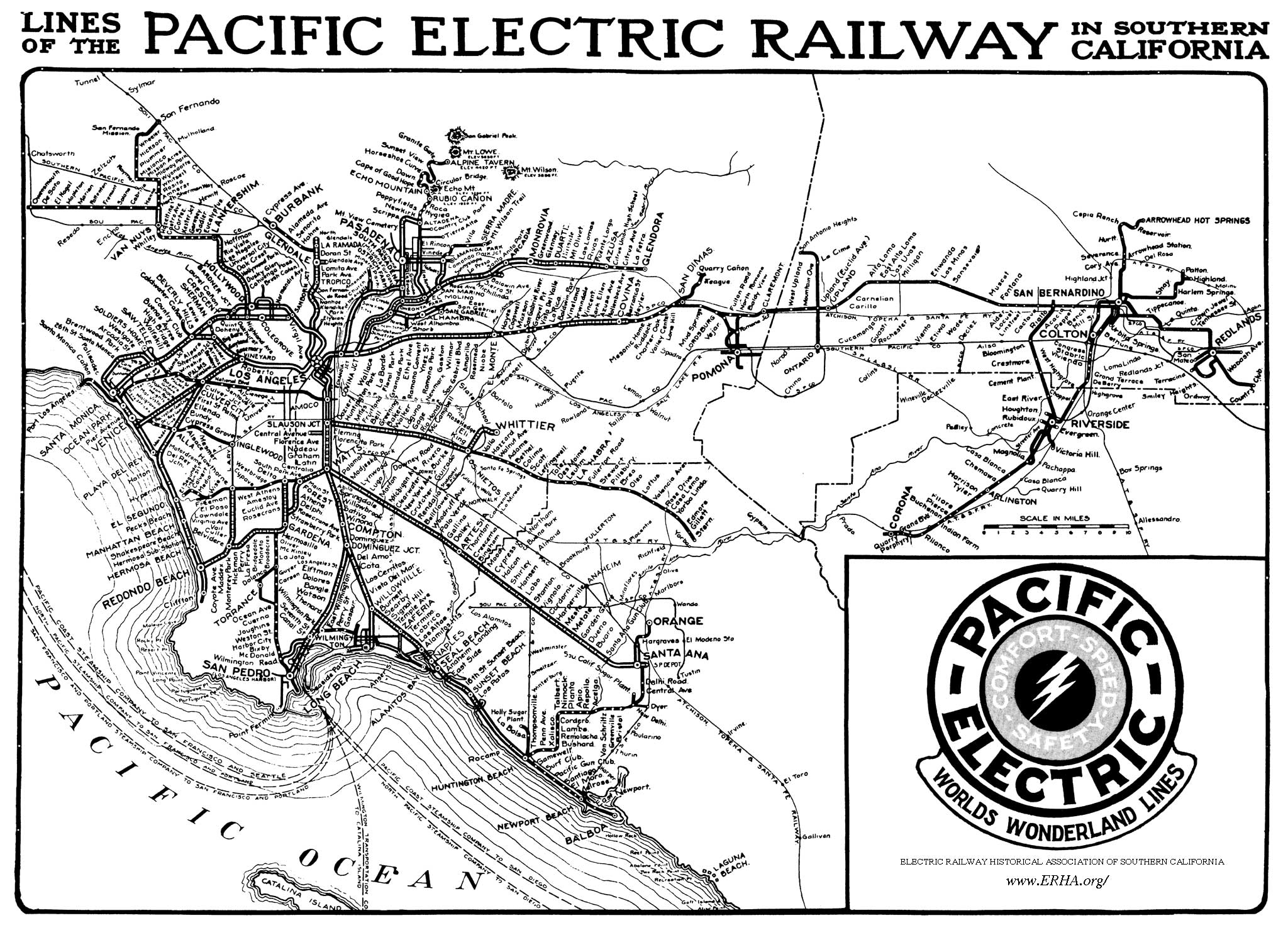
This is perhaps the silliest part of my proposal, but maybe the most fun. There are plenty of precedents (here, here, here, here) of fantastical transit maps of Los Angeles, all more comprehensive than mine. Part of my thinking about the site relates to bundling and unbundling multiple modes of transportation–high speed rail, heavy rail (Metrolink), tramway (this), buses, cars, bicycles, and pedestrians. If there's to be a tramway, I propose this, my San Fernando line, running from Sherman Oaks at Ventura/Van Nuys to the Sylmar/San Fernando HSR station through some of the densest parts of the Valley. Most of it could operate in the old Pacific Electric streetcar right-of-ways, as well, since it basically follows the alignment of the old 33 and 84 Red Car lines, as far as I can tell (and, more roughly, the current 734 Metro Rapid service). But the San Fernando Valley isn't Bordeaux, so it's not like I'm holding my breath or anything.
This is perhaps the silliest part of my proposal, but maybe the most fun. There are plenty of precedents (here, here, here, here) of fantastical transit maps of Los Angeles, all more comprehensive than mine. Part of my thinking about the site relates to bundling and unbundling multiple modes of transportation–high speed rail, heavy rail (Metrolink), tramway (this), buses, cars, bicycles, and pedestrians. If there's to be a tramway, I propose this, my San Fernando line, running from Sherman Oaks at Ventura/Van Nuys to the Sylmar/San Fernando HSR station through some of the densest parts of the Valley. Most of it could operate in the old Pacific Electric streetcar right-of-ways, as well, since it basically follows the alignment of the old 33 and 84 Red Car lines, as far as I can tell (and, more roughly, the current 734 Metro Rapid service). But the San Fernando Valley isn't Bordeaux, so it's not like I'm holding my breath or anything.
06 December 2009
I found this item in the Wall Street Journal to be particularly interesting. While urban and especially suburban property values have plummeted,
the average residential sale price climbed 7% last year from 2006 levels, before the recession began. This year, says the firm, based in Kansas City, Mo., prices are expected to be up 2% from 2006. That's compared to an expected 22% median price decline nationally in existing single-family homes in 2009 from 2006 levels.
So now more people are moving out of cities and suburbs and heading for the country, or at least the exurban fringes, what Leo Marx would call "ruburbia."¹ Being a ruburban myself, and perhaps what this article might consider a second generation 'ruralpolitan', it's not surprising at all that city-folk would turn to the country in an economic downturn. Here the city is seen as the site of economic instability and unpredictability, and the countryside, as always, its antidote. This deep-seated anti-urbanism is congenital to American development, and the desire to be both outside the city yet connected to its commercial and social benefits is fundamental to the history of sprawl–and, indeed, suburbia in general. For me, then, this is just a further development of centrifugal growth, and, more broadly, another iteration of the tradition, from Jefferson's gentleman-farmer-citizen to Wright's Broadacre City, of binding political hope to the landscape.
With the possibilities of the internet and 'online commuting,' now even the most rural community can be, effectively, a bedroom community. What's worrying is that these displaced suburbanites aren't likely to drastically alter their lifestyles to suit their new environments; most importantly, they aren't likely to give up their dependence on the car. If anything, moving to the country aggravates one's reliance on the car in daily life. The supermarket, instead of being four or five miles away, is now ten or twenty. School is thirty; work, in this article's example, is sixty. Any sort of community thought to be found or made, as opposed to the anonymity of the city, will be stretched to its physical limits. While this certainly seems like a fleeting trend (the move to the city being one of the more inescapable forces of the modern age), it's not hard to see that, if combined with the small town nostalgia-mongering of the worst of the New Urbanists, it could prove to be a significant real estate development or even planning trend.
[1] see Leo Marx, "The American Ideology of Space" in Denatured Visions
Also:
He and his nine-year-old, James, decided to try killing one—"My wife didn't want anything to do with that," he says—and cooking it. It turns out that roosters can be tough. "We took one bite and it was like, 'We can't eat this thing,' " says Mr. Dawley.
Isn't that why you cook it for like a whole day in red wine and make coq au vin? C'mon now people.
the average residential sale price climbed 7% last year from 2006 levels, before the recession began. This year, says the firm, based in Kansas City, Mo., prices are expected to be up 2% from 2006. That's compared to an expected 22% median price decline nationally in existing single-family homes in 2009 from 2006 levels.
So now more people are moving out of cities and suburbs and heading for the country, or at least the exurban fringes, what Leo Marx would call "ruburbia."¹ Being a ruburban myself, and perhaps what this article might consider a second generation 'ruralpolitan', it's not surprising at all that city-folk would turn to the country in an economic downturn. Here the city is seen as the site of economic instability and unpredictability, and the countryside, as always, its antidote. This deep-seated anti-urbanism is congenital to American development, and the desire to be both outside the city yet connected to its commercial and social benefits is fundamental to the history of sprawl–and, indeed, suburbia in general. For me, then, this is just a further development of centrifugal growth, and, more broadly, another iteration of the tradition, from Jefferson's gentleman-farmer-citizen to Wright's Broadacre City, of binding political hope to the landscape.
With the possibilities of the internet and 'online commuting,' now even the most rural community can be, effectively, a bedroom community. What's worrying is that these displaced suburbanites aren't likely to drastically alter their lifestyles to suit their new environments; most importantly, they aren't likely to give up their dependence on the car. If anything, moving to the country aggravates one's reliance on the car in daily life. The supermarket, instead of being four or five miles away, is now ten or twenty. School is thirty; work, in this article's example, is sixty. Any sort of community thought to be found or made, as opposed to the anonymity of the city, will be stretched to its physical limits. While this certainly seems like a fleeting trend (the move to the city being one of the more inescapable forces of the modern age), it's not hard to see that, if combined with the small town nostalgia-mongering of the worst of the New Urbanists, it could prove to be a significant real estate development or even planning trend.
[1] see Leo Marx, "The American Ideology of Space" in Denatured Visions
Also:
He and his nine-year-old, James, decided to try killing one—"My wife didn't want anything to do with that," he says—and cooking it. It turns out that roosters can be tough. "We took one bite and it was like, 'We can't eat this thing,' " says Mr. Dawley.
Isn't that why you cook it for like a whole day in red wine and make coq au vin? C'mon now people.
01 December 2009
So even though I'm officially on charrette for my fall semester studio project, I'm utterly preoccupied by my thesis paper. Although I had a fairly complete outline nearly three weeks ago, I've been restructuring the paper continually. Here's the basic format, shown with the quotes at the heart of the research for each point:
I. Life on the Edge of the City
On the fringe of mass Suburbia, even the advantages of the primary neighborhood group disappear. The cost of this detachment in space from other men is out of all proportion to its supposed benefits. The end product in an encapsulated life, spent more and more either in a motor car or within the cabin of darkness before a television set. [...] Those who accept this existence might as well be encased in a rocket hurtling through space, so narrow are their choices, so limited and deficient their permitted responses. Here indeed we find ‘The Lonely Crowd.’
Lewis Mumford, The City in History
II. Publicity and Everyday Life
We do not, after all, experience the city blankly, and much of what we do absorb from daily life in the city (be it the long drag of the commute, the jostle of the subway crowds, the blandness of the shopping mall, the elegance or grandeur of certain forms of urban architecture, the panhandlers on the sidewalk, or the peace and beauty of an urban park) surely has some kind of influence on how we are situated in the world and how we think and act politely within it.
David Harvey, The Political Economy of Public Space
[...] these spaces are like everyday life: 'trivial, obvious but invisible, everywhere and nowhere.' For most Angelenos, such spaces constitute an everyday reality of infinitely recurring commuting routes and trips to the supermarket, dry cleaner, or video store. The sites for multiple social and economic transactions, these mundane places serve as primary intersections between the individual and the city. [...] This realm of public life lies outside the domain of electoral politics or professional design [...] Unlike normative public spaces, which produce the existing ideology, these spaces help to overturn the status quo.
Margaret Crawford, Blurring the Boundaries: Public Space and Private Life
III. Modernity and Mobility
La ville qui dispose de la vitesse dispose du succès.
Le Corbusier, Urbanisme
One could achieve speed not by concentrating but by fragmenting the urban, opening up the dense fabric to allow the automobile to run free, exploding the city in fragments over whole regions. With urban functions no longer confined within the dense environment of the central city, homes, factories, offices, and stores could spread out and merge with the landscape. Here potentially was a new synthesis of speed and space unknown to urban history.
Robert Fishman, Beyond Sprawl
IV. Density and Democracy
The tolerance, the room for great differences among neighbors–differences that often go far deeper than differences in color–which are possible and normal in intensely urban life, but which are so foreign to suburbs and pseudosuburbs, are possible and normal only when streets of great cities have built-in equipment allowing strangers to dwell in peace together on civilized but essentially dignified and reserved terms.
Jane Jacobs, The Death and Life of Great American Cities
The only indispensible material factor in the generation of power is the living together of people. Only where men live so close together that the potentialities of action are always present can power remain with them, and the foundation of cities, which as city-states have remained paradigmatic for all Western political organization, is therefore indeed the most important material prerequisite for power.
Hannah Arendt, The Human Condition
V. Toward Public Space as Resistance
It is here, perhaps, with the potential of physical space for sustaining face-to-face, confrontational discussion and debate, that the architect resurfaces as an agent who still has some marginal critical relevance in the late-modern world. How else, other than by providing a provocative public micro-realm, can the architectural profession significantly intervene in the universal megalopolis?
Kenneth Frampton, Land Settlement, Architecture, and the Eclipse of the Public Realm
I've got two weeks to pull this thing together.
I. Life on the Edge of the City
On the fringe of mass Suburbia, even the advantages of the primary neighborhood group disappear. The cost of this detachment in space from other men is out of all proportion to its supposed benefits. The end product in an encapsulated life, spent more and more either in a motor car or within the cabin of darkness before a television set. [...] Those who accept this existence might as well be encased in a rocket hurtling through space, so narrow are their choices, so limited and deficient their permitted responses. Here indeed we find ‘The Lonely Crowd.’
Lewis Mumford, The City in History
II. Publicity and Everyday Life
We do not, after all, experience the city blankly, and much of what we do absorb from daily life in the city (be it the long drag of the commute, the jostle of the subway crowds, the blandness of the shopping mall, the elegance or grandeur of certain forms of urban architecture, the panhandlers on the sidewalk, or the peace and beauty of an urban park) surely has some kind of influence on how we are situated in the world and how we think and act politely within it.
David Harvey, The Political Economy of Public Space
[...] these spaces are like everyday life: 'trivial, obvious but invisible, everywhere and nowhere.' For most Angelenos, such spaces constitute an everyday reality of infinitely recurring commuting routes and trips to the supermarket, dry cleaner, or video store. The sites for multiple social and economic transactions, these mundane places serve as primary intersections between the individual and the city. [...] This realm of public life lies outside the domain of electoral politics or professional design [...] Unlike normative public spaces, which produce the existing ideology, these spaces help to overturn the status quo.
Margaret Crawford, Blurring the Boundaries: Public Space and Private Life
III. Modernity and Mobility
La ville qui dispose de la vitesse dispose du succès.
Le Corbusier, Urbanisme
One could achieve speed not by concentrating but by fragmenting the urban, opening up the dense fabric to allow the automobile to run free, exploding the city in fragments over whole regions. With urban functions no longer confined within the dense environment of the central city, homes, factories, offices, and stores could spread out and merge with the landscape. Here potentially was a new synthesis of speed and space unknown to urban history.
Robert Fishman, Beyond Sprawl
IV. Density and Democracy
The tolerance, the room for great differences among neighbors–differences that often go far deeper than differences in color–which are possible and normal in intensely urban life, but which are so foreign to suburbs and pseudosuburbs, are possible and normal only when streets of great cities have built-in equipment allowing strangers to dwell in peace together on civilized but essentially dignified and reserved terms.
Jane Jacobs, The Death and Life of Great American Cities
The only indispensible material factor in the generation of power is the living together of people. Only where men live so close together that the potentialities of action are always present can power remain with them, and the foundation of cities, which as city-states have remained paradigmatic for all Western political organization, is therefore indeed the most important material prerequisite for power.
Hannah Arendt, The Human Condition
V. Toward Public Space as Resistance
It is here, perhaps, with the potential of physical space for sustaining face-to-face, confrontational discussion and debate, that the architect resurfaces as an agent who still has some marginal critical relevance in the late-modern world. How else, other than by providing a provocative public micro-realm, can the architectural profession significantly intervene in the universal megalopolis?
Kenneth Frampton, Land Settlement, Architecture, and the Eclipse of the Public Realm
I've got two weeks to pull this thing together.
28 November 2009
While architects in general are quite good at lamenting the insignificance of their role in any design project (see all that 75 percent anxiety), it's good to see someone else thinking of HSR as an architectural opportunity.
Last month, [Joseph] Bellomo sent a letter to the rail authority, the state agency charged with building the $45 billion rail line, proposing a two-tiered international competition in which architects and designers from around the world would send in proposed designs for the entire line. The proposals would be narrowed to three finalists whose ideas would be further developed.
"The only way to get good design, holistic design, is through competition," Bellomo said.
"The only way to get good design, holistic design, is through competition," Bellomo said.
I'm not entirely sold, however, on his idea to tackle the whole 800 mile route at once, as a single project. How does one even begin to design a cohesive plan for that kind of a site? Or would you just have a very general scheme for different types of corridors? Over 800 miles, the exceptions and specifics would add up very fast. Still, the idea of a consistent design idea is an admirable enough goal. Read the whole competition proposal here.
24 November 2009
In all my reading, I've found plenty of support for my thesis of transportation as a generator of public space. In spite of all the encouragement, however, it's pretty disheartening to read something like this (especially from an author you admire):
In dispersed areas, architects will have to give up on their dream of fixed rail transit as a generator of public spaces. Margaret Crawford, "Architecture and Dispersal"
"Giving up the dream" is a tough idea to swallow in the middle of one's thesis project, and, I suspect, a little counterproductive. Coming to terms with the realities around an academic architecture project is one thing; dispensing with everything critical and subversive and theoretically challenging about the project is another entirely. Finding a balance between castles-in-the-air design and concession to the status quo is a particularly anxiety-ridden task for every architect worth his or her salt, I suppose, and there's already an echo-chamber of debate on the topic (well worth reading, nonetheless).
I started the semester with this paragraph, from my original thesis proposal:
Designers must be able to productively address the American suburb and still maintain an energy of resistance and social progress, working to change the system from within that system itself. In order to effect real positive change in the public realm, architecture must engage the political realities of its production, rejecting positions of either detached criticality or enthusiastic “pragmatism”. By addressing the politics of program, site, and construction through design, without retreating into metaphorical abstraction or surrendering to glib commercialism, architecture can regain meaning and relevance in the lives of its users.
I still agree (kind of), but it's taken me another three months or so to decide that, for this project, I'd rather error on the side of 'critical detachment'. I realized this sometime around 5am last week, when, as I was verifying that my site plan drawing was accurate down to the hundredth of a foot, it occurred to me that it doesn't really matter because I'm still in school. Now: while it's not like I want to design in a vacuum, I do hope to maintain a certain critical ambition throughout the design process.
21 November 2009
[...] Another interesting thing about de Certeau's views is that he has a faith in collective creativity of subjects, in their tendency to invent ways to use the spaces that are given to them. You could argue that the traditional notion of public space is a kind of top-down argument whereby public space is 'given' to the public. I would turn that equation around to say: how does the collective create public space with the spaces that are given/found? This means that the role of the architect is to make a space for that public – to create the conditions where the public can freely exercise its collective creativity. It's for this reason that I've always been suspicious of the attempt to overscript the use of public space. For me, a successful public space is precisely a space where something unanticipated happens.
16 November 2009

07 November 2009

04 November 2009
Protected from direct antagonistic competition and with large quantities of surplus value at its disposal, the large corporation faces an acute problem of finding a market to absorb expanding output as well as to help expand the rate of circulation of surplus value. The corporation must therefore create, maintain and expand the effective demand for its products. There are various strategems available. Perhaps the most successful is to create a need while eliminating the possibility for that need to be met by a substitution of product. The effective demand for automobiles (as well as oil products, highway construction, suburban construction, etc.) has been created and expanded through the total reconfiguration of the metropolitan built form so that it is all but impossible to live a "normal" social life without a car [...] A need has been created out of a luxury.
David Harvey: Social Justice and the City
03 November 2009
If we are ever to come to terms with the current proliferation of the megalopolis in both a socio-cultural and ecological sense, then we shall only be able to do so in a post-facto compensatory way, that is to say by adopting denser patterns of land settlement and by providing adequate infrastructure for public transport, operating at differentiated speeds – from fast inter-city trains to slower intra-city light rail transit systems, augmented by buses. As far as the first is concerned I have in mind the high-speed train that has been an ongoing development project in Europe and Japan for the last 35 years, with the result that today for inter-city journeys of up to 500 kilometres, rail has become preferable to air travel in terms of trip time, reliability, energy consumption and environmental pollution.
Kenneth Frampton: "On the Predicament of Architecture at the Turn of the Century"
Thanks for summarizing the first three-quarters of my thesis project!
16 October 2009

[...] the privatized model of urban development embodies no nonmercantile aspirations. Suburbia today conforms to a simplistic, low-density, auto-dependent, money-driven model. [...] What one drives by in the typical American suburb is the result of little more than thousands of purely economic transactions. And in this instrumental landscape, each individual development is manufactured and considered only within its own short-term economic parameters. Any sense of a larger community or shared culture must struggle against the physical impediments of distance and the devotion to the automobile.
James S. Russell: "Privatized Lives: On the Embattled ‘Burbs"
(N.B. the Futura on the sign! Well played, Metrolink.)
13 October 2009
Although I was supposed to spend the weekend in Newark, it’s only a short ride on PATH from Jersey to New York, so there was really no way I was going to sit through a boring conference about slippery ideas like “leadership” and “networking” when instead I could be walking around Soho and the West Village. I regret nothing. The city is wonderful and I’m more than willing to use any excuse I can cook up to visit.
For what it’s worth, I think the High Line is fabulous¹. The architectural details are thoughtful and well-designed, the landscaping is superb, and the view of the city is at once refreshing and reässuring; the perspective is new but the city is the New York we know and love. While some of the ambition of the original design has been compromised (no wetlands suspended over 14th St? Will we still get that awesome tree lift?), it’s still a very impressive place. Even the fact that it’s there at all is exciting, and I can’t help but wonder how many other potential gems are hidden in the city, waiting to be found. (Los Angeles, capital city of underutilization and missed opportunity, has taught me all about this.)

In the new urban chemistry of New York, the High Line is both a byproduct and catalyst of gentrification. This is clear both in the glitter of the starchitecture developments springing up around it and the people who come here. Yet walking amid the hipsters and tourists, I was surprised by the pacing of the whole experience. It's impossible to hurry here, not that you'd want to. Field Operations artfully segmented the path into landscaped episodes–grasslands, woodlands, open spaces, and more intimate ones–and the result is a true urban oasis. This is reflected in the way people use the space: they sit and read, eat their lunches, crowd-watch. Many were, like me, taking snapshots with their digital SLRs; others leaned over the railings and gazed at the city below. Most of all, people simply stroll (and in lower Manhattan, this is a sight to behold).

Much of this, I suppose, has to do with scale. The vast acreage of Central Park allows for programming like baseball fields, ice-skating rinks, and amphitheaters. The wider, eastern half of the Promenade Plantée–the only real precedent for the High Line, running along an old rail route through the 12th in Paris–is crowded with local joggers and cyclists; here there is really only room for strolling. You go to there just to be there, not to go anywhere or do anything besides escape the sidewalk. Unlike Central Park, on the High Line everyone’s a tourist. After all, it doesn’t go anywhere anymore. It’s just there, a narrow park floating over Chelsea. Ostensibly it connects, or will someday connect, the Meatpacking District with Hudson Yards, but no one actually walking between those two places would use its meandering path for expedience. As a landscape, it is not a means but and end to itself. As a public space, the High Line is social rather than instrumental.²

The creation of public space from the ruins of vestigial infrastructure is, in a way, the inverse of the Sylmar project, which is about using new infrastructure as an opportunity to create public space. I’m not looking to repurpose anything, or to change one thing into another, but, by coupling public transportation and public space, actuate them both. Their relationship should be one of mutual enablement. On one hand, connecting the rail station to the city with public space will embed the station into the fabric of the city–an essential part of making mass transit work for American suburbia. On the other hand, attaching real function to the space transforms it–as a place, is not passive but active, neither a park (social) nor a plaza (civic) but an instrumental space. The reciprocity of these two aspects is vital to the project: the more people ride the train, the more lively the space; the more lively the space, the more people are drawn to the train. And with ridership projections at 16,000 passengers a day, Sylmar may be the busiest station between Los Angeles and San Francisco, so the numbers are there. The key will be in how the link is designed–my job in the spring.
PS The pedestrianization of Times Square is awesome, even if the place is still full of European and Midwestern tourists. I didn’t know, though, that the thing at the very apex of the intersection was an Olive Garden.
[2] see Elizabeth Blackmar, "Appropriating the Commons: The Tragedy of Property Rights Discourse" for transportation facilities and the public realm.
For what it’s worth, I think the High Line is fabulous¹. The architectural details are thoughtful and well-designed, the landscaping is superb, and the view of the city is at once refreshing and reässuring; the perspective is new but the city is the New York we know and love. While some of the ambition of the original design has been compromised (no wetlands suspended over 14th St? Will we still get that awesome tree lift?), it’s still a very impressive place. Even the fact that it’s there at all is exciting, and I can’t help but wonder how many other potential gems are hidden in the city, waiting to be found. (Los Angeles, capital city of underutilization and missed opportunity, has taught me all about this.)
In the new urban chemistry of New York, the High Line is both a byproduct and catalyst of gentrification. This is clear both in the glitter of the starchitecture developments springing up around it and the people who come here. Yet walking amid the hipsters and tourists, I was surprised by the pacing of the whole experience. It's impossible to hurry here, not that you'd want to. Field Operations artfully segmented the path into landscaped episodes–grasslands, woodlands, open spaces, and more intimate ones–and the result is a true urban oasis. This is reflected in the way people use the space: they sit and read, eat their lunches, crowd-watch. Many were, like me, taking snapshots with their digital SLRs; others leaned over the railings and gazed at the city below. Most of all, people simply stroll (and in lower Manhattan, this is a sight to behold).
Much of this, I suppose, has to do with scale. The vast acreage of Central Park allows for programming like baseball fields, ice-skating rinks, and amphitheaters. The wider, eastern half of the Promenade Plantée–the only real precedent for the High Line, running along an old rail route through the 12th in Paris–is crowded with local joggers and cyclists; here there is really only room for strolling. You go to there just to be there, not to go anywhere or do anything besides escape the sidewalk. Unlike Central Park, on the High Line everyone’s a tourist. After all, it doesn’t go anywhere anymore. It’s just there, a narrow park floating over Chelsea. Ostensibly it connects, or will someday connect, the Meatpacking District with Hudson Yards, but no one actually walking between those two places would use its meandering path for expedience. As a landscape, it is not a means but and end to itself. As a public space, the High Line is social rather than instrumental.²
The creation of public space from the ruins of vestigial infrastructure is, in a way, the inverse of the Sylmar project, which is about using new infrastructure as an opportunity to create public space. I’m not looking to repurpose anything, or to change one thing into another, but, by coupling public transportation and public space, actuate them both. Their relationship should be one of mutual enablement. On one hand, connecting the rail station to the city with public space will embed the station into the fabric of the city–an essential part of making mass transit work for American suburbia. On the other hand, attaching real function to the space transforms it–as a place, is not passive but active, neither a park (social) nor a plaza (civic) but an instrumental space. The reciprocity of these two aspects is vital to the project: the more people ride the train, the more lively the space; the more lively the space, the more people are drawn to the train. And with ridership projections at 16,000 passengers a day, Sylmar may be the busiest station between Los Angeles and San Francisco, so the numbers are there. The key will be in how the link is designed–my job in the spring.
PS The pedestrianization of Times Square is awesome, even if the place is still full of European and Midwestern tourists. I didn’t know, though, that the thing at the very apex of the intersection was an Olive Garden.
[1] For other notes around the High Line, see this, this, and this, as well as JHK's predictable bitchfest here.
[2] see Elizabeth Blackmar, "Appropriating the Commons: The Tragedy of Property Rights Discourse" for transportation facilities and the public realm.
05 October 2009
Being in the midst of my own thesis and curious if not skeptical about the very nature of an architectural thesis, I walked to SCI-Arc this weekend to see their graduate thesis exhibition. I’ve gone a few times before and enjoyed the work. Student work, at its best, provokes and inspires, and few schools have the reputation for innovative work that SCI-Arc has earned. This year, however, instead of giving out one award for the best thesis, the school gave four. It’s easy to see why: as a group, the projects weren’t merely unimpressive–they were boring. Scandalously boring, really. The eight or so projects on display were uniformly mediocre; there were a few good renderings, as usual, but many graphics were ugly, illegible, and some were badly pixelated. Precedent studies were sloppy and predictable. And not to get all William Safire on you, but the presentation texts were poorly written and full of grammar and spelling errors (and questionable Deleuze references, but that’s a separate issue). I’m sorry, but if this is your graduate thesis presentation, how have you (and your instructor!) not read over your abstract a hundred times? I suppose there aren’t any red squiggly lines in Illustrator.
Most offensive of all was the overwhelming lack of urgency in the projects. Careless presentation is one thing; poverty of critical thought is another. There was all the Maya and V-ray and Rhinoscripting you’d expect to see, but nothing else, nothing beyond the blob. One project explored the geometric possibilities of “banal figures” such as the rubber ducky. Another fearlessly tackled the perennial issue of cuteness. One of the winners of the best M.Arch thesis award affixed huge baroque arabesques and curlicues to a generic building and twisted them into a gothic-looking tower straight out of some DeviantArt dystopia.
This makes me sound more curmudgeonly than I mean to be. It’s not like this kind of form-making is particularly wrong or morally reprehensible, nor is it uninteresting. Yet there seems to a failure to harness the technology and use it as a means to an end beyond itself. They may be interesting as isolated exercises, but I lose patience when they’re posed as architectural theses and I’m left asking that most frustrating of questions: so what? What then is a thesis? How does one argue through architecture, and, more importantly, what do we argue for? The SCI-Arc projects I saw were dull because, after form, there was nothing. I’m not sure whether to chalk it up to myopia or nihilism–could they not see past the final rendering or did they just not care?
Today I organized a meeting with a few other fifth-year students to discuss our ownthesis degree projects. People talked about coastal settlements and rising sea levels, politicized war memorials, militant agriculture in Palestine, border crossings, homeless shelters on Skid Row, and a chancery. There are two things happening here that I didn’t see at SCI-Arc: architectural ideas born out of social awareness and diversity of direction. Hopefully we’ll all come out with very different projects that are not only innovative and beautiful but thoughtful and relevant.
Most offensive of all was the overwhelming lack of urgency in the projects. Careless presentation is one thing; poverty of critical thought is another. There was all the Maya and V-ray and Rhinoscripting you’d expect to see, but nothing else, nothing beyond the blob. One project explored the geometric possibilities of “banal figures” such as the rubber ducky. Another fearlessly tackled the perennial issue of cuteness. One of the winners of the best M.Arch thesis award affixed huge baroque arabesques and curlicues to a generic building and twisted them into a gothic-looking tower straight out of some DeviantArt dystopia.
This makes me sound more curmudgeonly than I mean to be. It’s not like this kind of form-making is particularly wrong or morally reprehensible, nor is it uninteresting. Yet there seems to a failure to harness the technology and use it as a means to an end beyond itself. They may be interesting as isolated exercises, but I lose patience when they’re posed as architectural theses and I’m left asking that most frustrating of questions: so what? What then is a thesis? How does one argue through architecture, and, more importantly, what do we argue for? The SCI-Arc projects I saw were dull because, after form, there was nothing. I’m not sure whether to chalk it up to myopia or nihilism–could they not see past the final rendering or did they just not care?
Today I organized a meeting with a few other fifth-year students to discuss our own
01 October 2009

30 September 2009



First things first. A log is, by definition, a record of progress. There’s a fun etymology here: a ship would drop a piece of wood (thus “log”) attached to a reel of line into its wake, and as the vessel moved away, sailors would measure the amount of line that had unwound and so determine the their speed. The documentation of these measurements became the ship’s log. While I hope this blog won’t become too much of a drag (as it were), I think it should be immensely useful as a document of my process as it happens. Not only will it give me a way to gauge my pace, but the public nature of the weblog will, ideally, keep me accountable. Even if my readers are imaginary.
If I can manage it as planned, this blog will be a tool by which I can regularly report what I’ve done: readings, research, design, drawings, &c. In the end, my hope is that this place will be just as important (and useful) as the rest of my thesis material, and only slightly more narcissistic. So here goes.
If I can manage it as planned, this blog will be a tool by which I can regularly report what I’ve done: readings, research, design, drawings, &c. In the end, my hope is that this place will be just as important (and useful) as the rest of my thesis material, and only slightly more narcissistic. So here goes.
27 September 2009
Provenance
Thesis proposal: The advent of high speed rail in California is an opportunity to reconfigure how transportation infrastructure relates to the public realm. The sustainable advantages of intercity rail travel will be lost if the link between train and city is not considered as a positive, accessible public place. Using this chance to create highly functional commuter spaces coupled with a broader urban strategy that addresses the way stations integrate with the community on the urban fringe, can architecture again work for progressive social change? How might the architecture of transportation infrastructure perform as a catalyst for the creation of public landscapes on the edge of the American city?
Subscribe to:
Posts (Atom)